Sunday, 4 March 2012

Ice, Heat and injuries

Acute and Chronic Injuries


Acute injuries are sudden, sharp, traumatic injuries that occur immediately (or within hours) and cause pain (possibly severe pain). Most often acute injuries result from some sort of impact or trauma such as a fall, sprain, or collision and it's pretty obvious what caused the injury.
Acute injuries also cause common signs and symptoms of injury such as pain, tenderness, redness, skin that is warm to the touch, swelling and inflammation. If you have swelling, you have an acute injury.
Chronic injuries, on the other hand, can be subtle and slow to develop. They sometimes come and go, and may cause dull pain or soreness. They are often the result of overuse, but sometimes develop when an acute injury is not properly treated and doesn't heal.
ice or heat
 

Acute and Chronic Pain

There are two basic types of athletic injuries: acute and chronic.
Acute Pain is of rapid onset and short-lived, or Chronic Pain develops slowly and is persistent and long-lasting.

    Acute and Chronic Injuries

    Acute injuries are sudden, sharp, traumatic injuries that occur immediately (or within hours) and cause pain (possibly severe pain). Most often acute injuries result from some sort of impact or trauma such as a fall, sprain, or collision and it's pretty obvious what caused the injury. Acute injuries also cause common signs and symptoms of injury such as pain, tenderness, redness, skin that is warm to the touch, swelling and inflammation. If you have swelling, you have an acute injury.  Chronic injuries, on the other hand, can be subtle and slow to develop. They sometimes come and go, and may cause dull pain or soreness. They are often the result of overuse, but sometimes develop when an acute injury is not properly treated and doesn't heal.
  • Cold Therapy with Ice Cold therapy with ice is the best immediate treatment for acute injuries because it reduces swelling and pain. Ice is a vaso-constrictor (it causes the blood vessels to narrow) and it limits internal bleeding at the injury site. There is controversy as to whether continued application of ice results in a sudden vasodilation of the blood vessels (the hunting response) and if so, at what time this response begins and how often a cycle of constriction and dilation occurs. To ice an injury, wrap ice in a thin towel and place it on the affected area for 10 minutes at a time. Allow the skin temperature to return to normal before icing a second or third time. You can ice an acute injury several times a day for up to three days. Cold therapy is also helpful in treating some overuse injuries or chronic pain in athletes. An athlete who has chronic knee pain that increases after running may want to ice the injured area after each run to reduce or prevent inflammation. The best way to ice an injury is with a high quality ice pack that conforms to the body part being iced.  You can get good results from a bag of frozen peas, an ice massage with water frozen in a paper cup (peel the cup down as the ice melts) or a bag of ice.
  • There is however debate as to whether ice should be used at all.  As mentioned above, ice will reduce inflamation however slow blood flow to the injury.  Conflicting opinions have arisen as to whether reducing the inflamation and inhibiting the blood flow(using ice) actually has a negitive effect on the long term recovery of the injury as blood flow helps in the recovery process of injury.    Heat Therapy Heat is generally used for chronic injuries or injuries that have no inflammation or swelling. Sore, stiff, nagging muscle or joint pain is ideal for the use of heat therapy. Athletes with chronic pain or injuries may use heat therapy before exercise to increase the elasticity of joint connective tissues and to stimulate blood flow. Heat can also help relax tight muscles or muscle spasms. Don't apply heat after exercise. After a workout, ice is the better choice on a chronic injury. Because heat increases circulation and raises skin temperature, you should not apply heat to acute injuries or injuries that show signs of inflammation. Safely apply heat to an injury 15 to 20 minutes at a time and use enough layers between your skin and the heating source to prevent burns. Moist heat is best, so you could try using a hot wet towel. You can buy special athletic hot packs or heating pads if you use heat often. Never leave heating pads on for more than 20 minutes at a time or while sleeping. Because some injuries can be serious, you should see your doctor if your injury does not improve (or gets worse) within 48 hours.
  • Source About.com Sports Medicine
  • Thursday, 9 February 2012

    Not surfing so well today? Whats your warm up like?

    Have you ever thrown your wetty on, grabbed your board and jumped straight into the surf and wondered why you surfed so badly?  Here's a tip:  Surfing is an extreamly dynamic sport which involves twisting, weight transferring, balance, core stability and cardio vascular fitness to name a few.
    Its no secret the top professional surfers are now regarded as elite sportsman using personal trainers to gain that all important edge on rivals.  The beach bums and dole bludgers of years previous have come a long way!!
    Take alook at what Mick Fanning does before a heat and consquently the flexibility and fluidness of his surfing!  
    http://www.youtube.com/watch?v=V4XXtHztnEU
    Mick Fanning Hurley U.S. Open of Surfing
    A surfing warm should involve dynamic exercises to mimic what is going to (hopefully)happen in the water.
    You'll notice Micks warm up incorporates twisting through out it.  If you were to break down his actions while surfing you will notice how the core is involved in most actions and the body twist regularly.  Check his torso positioning to legs during a cut back or tailslide.
    Are you going to warm up next time?  I am!!

    Wednesday, 1 February 2012

    Exercise in Pregnancy

    Pregnancy used to spell the end of a woman's sporting career but in recent years many great female athletes have returned to their sport and competed at the highest level.
    How will pregnancy affect performance?
    Increase in body weight at an average of 10-15kg.  This has an effect on the body shape as weight is distributed in different areas.  In turn changing the centre of gravity which will result in extra curvature of the spine.
    Loosening of all ligaments.
    Caused by the hormone relaxin your joints will gradually loosen up.  This Crete's an increased injury risk. 
    Increase in resting heart rate.
    Due to the increase in resting and decrease in maximal HR it is not recommended using target heart rates to determine intensity in exercise.  This is best monitored by the mothers symptoms of exertion.  it is recommended you consult your doctor when assessing your your intensity.  She should stop when fatigued  and not exercise to exhaustion. 
    If using a HR to determine intensity, guidelines advise 140BPM.  This however is not an absolute.  A HR of 150-160 is reasonable for an active woman as long as no adverse symptoms are evident.
    Decrease in Blood Pressure
    During trimester 2, the development of blood vessels to supply the growing placenta will cause blood pressure to fall.  Spells of dizziness can prevail from sudden movements from lying to standing etc.  After month 4 lying on back exercises should be avoided due to weight of the foetus impeding on the return of blood to the heart.
    Pelvic Floor
    Damage to the pelvic floor muscles occur during birth.  The pelvic floor muscles are weakened during pregnancy so it is extremely important to begin conditioning of the these muscles from the outset.  Seek advice from your physio.  Persistent training of these muscles can help prevent bladder control problems and exercise related incontinence.
    Are there any dangers of exercise during pregnancy?
    Main concerns are
    • Over heating-avoid hot and humid conditions, poor ventilation.  Use breathable clothing and special attention to fluid replacement
    • Impairment of oxygen
    • nutrient delivery to the foetus
    • possible risk of premature delivery
    Risks to mother
    Pregnant women undergo many changes that have the potential to increase risks of injury.  Postural changes increasing lordosis, a shift in the centre of gravity and well as weight gain.  Particularly in the 2nd tri these can alter balance and co ordination.
    A change in hormonal levels aid in the relaxation and mobilisation of pelvic joints and can cause problems with instability and injury in the sacroilliac and pubic symphysis joints.  Avoid excessive stretching and ballistic movements.
    Precautions
    Exercise should be stopped if any abnormal symptoms occur such as pain, bleeding, dizziness or unusual breathing.
    Any exercise should not be undertaken without consulting your doctor or obsterician first.
    Pregnancy is not the time to start a more intense exercise program but rather continue and modify an existing one.  Its a time for maintenance not reaching heights.
    When can you resume after the baby is born.
    After a normal delivery gentle exercises can resume once you are comfortable.  More intense exercise should be delayed for 6 weeks after consultation with your doctor.  C section delivery should be 6 weeks minimum as long a wound has healed.
    Please stop if you experience any of the following
    • High HR
    • Dizziness
    • Headache
    • Uterine Contractions
    • Vaginal bleeding
    • Amniotic fluid leakage
    • Nausea
    • Insufficient weight gain
    • Shortness of breath
    • Back or pelvic pain
    • Decreased foetal movement
    • Sudden swelling of ankles, hands or face.
    Sports medicine Australia
    Women in sport-fact sheet 2

    Tuesday, 10 January 2012

    A guide for Carbohydrate intake while training

    How many carbohydrates should I be consuming if I am training or competing in an event?
    Its a question many athletes and sports people often ask.  Simply put, it depends on the frequency and time you are training.
    With out the correct intake of "carbs" it can seriously hinder your performance. 
    If the body doesn't get enough carbohydrate, it basically starts to shut down. Carbohydrates are converted to glucose which is used by your body and brain as fuel. Protein helps build muscle - it does not fuel your brain. It's like putting all kinds of oil in a car but no gas.
    Your cognitive functions will decrease, you'll feel tired and headachey, and possibly even nauseous.
    As a guideline please see table below

    Situation                                      Recommended carb intake

    Daily refuelling needs for training
    Programs less than 60-90min/day
    Or low intensity exercise
    Daily intake of 5-7g per kg of your body weight
    Daily refuelling needs for training
    Programs greater than 90-120mins/day
    Daily intake of 7-10g per kg of your body weight
    Daily refuelling for athletes undertaking extreme
    Exercise program of 6-8hrs per day(cycling etc)
    Daily intake of 10-12+g per kg of your body weight
    Carbohydrate loading for endurance and ultra endurance events
    Daily intake of 7-10g per kg of your body weight
    Pre event meal
    Meal eaten 1-4 hrs pre competition 1-4g/kg
    Body weight
    Carbohydrate intake during training sessions and competition events greater than 1 hr
    1g/min or 30-60 g/hour
    Rapid recovery after training session or multi day
    Competition, especially when there is less than 8 hrs until next session
    Intake of 1-1.5g/kg of BW for every hour in the early stages of recovery after exercise, contributing to a total intake of 6-10g/kg of BW over 24 hrs

    Source Australian institute of sport
     collaroy@stepintolife.com

    Self Myofascial Release

    As we get around in our hurried day to day activities we often neglect and respect our need to care for our bodies.  Being active can more often than not lead to having stiffness, lower back pain, tight muscles throughout your body and sometimes injuries.  Stretching is  a very underated and more times than not forgotten part of our exercise regimine. 
    Myofascial release is not a new form of stretching or massageing, however it is at times controversial as the following article from Sports Advisortm explains:

    Self Myofascial Release
    Self myofascial release techniques (SMRT), although not new, have become more and more prominent amongst athletes and fitness enthusiasts alike.
    Both allopathic and alternative Therapists have embraced the use of myofascial release massage to reduce chronic pain and rehabilitate a range of injuries. Some therapists claim a long list of benefits, from curing tennis elbow to IBS relief. While some claims may be contentious, it seems likely that many sports men and women can benefit from this regenerative therapy.
    Its important to understanding two key terms in order to appreciate how self myofascial release technique acts favourably on the body. They are fascia and trigger points. Both are explored below before moving on to some sample self myofascial release exercises.
    Self myofascial release techniques (SMRT), although not new, have become more and more prominent amongst athletes and fitness enthusiasts alike.
    Both allopathic and alternative Therapists have embraced the use of myofascial release massage to reduce chronic pain and rehabilitate a range of injuries. Some therapists claim a long list of benefits, from curing tennis elbow to IBS relief. While some claims may be contentious, it seems likely that many sports men and women can benefit from this regenerative therapy.
    Its important to understanding two key terms in order to appreciate how self myofascial release technique acts favourably on the body. They are fascia and trigger points. Both are explored below before moving on to some sample self myofascial release exercises.

    Fascia & Trigger Points

    Fascia is a specialized connective tissue layer surrounding muscles, bones and joints and gives support and protection to the body. It consists of three layers - the superficial fascia, the deep fascia and the subserous fascia. Fascia is one of the 3 types of dense connective tissue (the others being ligaments and tendons) and it extends without interruption from the top of the head to the tip of the toes.
    Fascia is usually seen as having a passive role in the body, transmitting mechanical tension, which is generated by muscle activity or external forces. Recently, however some evidence suggests that fascia may be able to actively contract in a smooth muscle-like manner and consequently influence musculoskeletal dynamics.
    Obviously, if this is verified by future research, any changes in the tone or structure of the fascia could have significant implications for athletic movements and performance. This research notwithstanding, the occurrence of trigger points within dense connective tissue sheets is thought to be correlated with subsequent injury.
    Trigger points have been defined as areas of muscle that are painful to palpation and are characterized by the presence of taut bands. Tissue can become thick, tough and knoted. They can occur in muscle, the muscle-tendon junctions, bursa, or fat pad. Sometimes, trigger points can be accompanied by inflammation and if they remain long enough, what was once healthy fascia is replaced with inelastic scar tissue.
    It has been speculated that trigger points may lead to a variety of sports injuries - from camps to more serious muscle and tendon tears. The theory, which seems plausible, is that trigger points compromise the tissue structure in which they are located, placing a greater strain on other tissues that must compensate for its weakness. These in turn can break down and so the spiral continues.
    According to many therapists, trigger points in the fascia can restrict or alter the motion about a joint resulting in a change of normal neural feedback to the central nervous system. Eventually, the neuromuscular system becomes less efficient, leading to premature fatigue, chronic pain and injury and less efficient motor skill performance. An athlete's worst nightmare!
    What causes a trigger point to form?
    The list of proposed causes includes acute physical trauma, poor posture or movement mechanics, over training, inadequate rest between training sessions and possibly even nutritional factors. Self myofascial release is a relatively simple technique that athletes can use to alleviate trigger points. Studies have shown myofascial release to be an effective treatment modality for myofascial pain syndrome although most studies have focused on therapist-based rather than self-based treatment.
    Self Myofascial Release Exercises
    For these exercises you will need a foam roll.

    Self myofascial adductor stretch Adductor Self Myofascial Release
    1. Extend the thigh and place foam roll in the groin region with body prone (face down) on the floor.
    2. Be cautious when rolling near the adductor complex origins at the pelvis.
    3. If a tender point is located, stop rolling, and rest on the tender point until pain decreases by 75%.


    Self myofascial hamstring stretchHamstring Self Myofascial Release
    1. Place hamstrings on the roll with hips unsupported.
    2. Feet can be crossed so that only leg at a time is one the foam roll.
    3. Roll from knee toward posterior hip.
    4. If a tender point is located, stop rolling, and rest on the tender point until pain decreases by 75%.
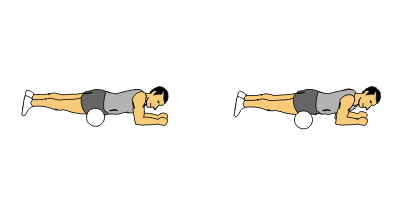


    Self myofascial quadriceps stretch Quadriceps Slef Myofascial Release
    1. Body is positioned prone (face down) with quadriceps on foam roll
    2. It is very important to maintain proper core control (abdominal drawn-in position & tight gluteus) to prevent low back compensations
    3. Roll from pelvic bone to knee, emphasizing the lateral (outside) thigh
    4. If a tender point is located, stop rolling, and rest on the tender point until pain decreases by 75%.


    Self myofascial IT band stretch Iliotibial Band Self Myofascial Release
    1. Position yourself on your side lying on foam roll.
    2. Bottom leg is raised slightly off floor.
    3. Maintain head in neutral position with ears aligned with shoulders.
    4. This may be PAINFUL for many, and should be done in moderation.
    5. Roll just below hip joint down the outside thigh to the knee.
    6. If a tender point is located, stop rolling, and rest on the tender point until pain decreases by 75%.
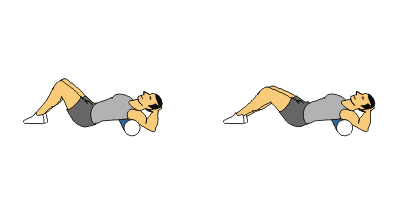


    Self myofascial upper back stretch Upper Back Self Myofascial Release
    1. Place hands behind head or wrap arms around chest to clear the shoulder blades across the thoracic wall.
    2. Raise hips until unsupported.
    4. Stabilize the head in a neutral position.
    5. Roll mid-back area on the foam roll.
    6. If a tender point is located, stop rolling, and rest on the tender point until pain decreases by 75%.

    General Guidelines

    • Spend 1-2 minutes per self myofascial release technique and on each each side (when applicable).
    • When a trigger point is found (painful area) hold for 30-45 seconds.
    • Keep the abdominal muscles tight which provides stability to the lumbo-pelvic-hip complex during rolling.
    • Remember to breathe slowly as this will help to reduce any tense reflexes caused by discomfort.
    • Complete the self myofascial release exercises 1-2 x daily.
    As you can see there are many benefits to self Myofascial release.  Time and effort spent is minimal for a maximal result. 

    collaroy@stepintolife.com


    Sunday, 8 January 2012

    Why New years resolutions don't work

    Avoid failure in 2012 with a New Year’s resolution!    
    Millions of Aussies will this week embark upon some sort of detox, diet or fitness plan. But according to a new study, the majority will fail, with the average dieter falling off the wagon after just 15 days. 
    Let me help you get started and make 2012 your year of good health
     Here are some pointers to help you stay on the wagon this new year.
    Go easy on yourself
    January can actually be the toughest and most depressing time of the year to set resolutions. It can really bring up a lot of familiar feelings of failure, shame and guilt.
     After drinking too much alcohol and eating lots of sugar  it takes time to rewire your brain and your blood chemistry to get back to being clean and lean again.  You need to give yourself a mental break.
    Don’t starve yourself
    It's really important that this doesn't become a miserable experience. Don't go cold turkey with your diet. Eat foods that nourish your body and make you feel good, rather than a steamed chicken breast and some dust.
    Don’t despair if you fall off the wagon
    Falling off the wagon is feedback, not failure. Think of this as a process - it's an opportunity to change your life for good, not just for a couple of weeks. If you do overindulge or fail to exercise when you promised you would, don't be too hard on yourself. It's part of learning how to get it right. 'It's easy to say, "I knew I'd never stick to these resolutions,"' and to give up. But don't despair. Pick yourself up and carry on.
    Focus on what motivates you
    If things are going to pot, sit down for 10 minutes and figure out why you want to get fit or lose weight. Is to be able to play with your children in the park? To stay healthy for your family? Look for the reason you're sticking to your resolutions. If you want to lose weight to guard against obesity-related illness in later life, perhaps think about the people in your life who love you, and who you love. Whatever drives you to stay healthy will help motivate you.
     Write down your goals
    In order to stick to the resolutions, writing down why you're doing them is a powerful and important part of the process. Make a list of the goals you want to achieve and the reasons why, and stick it somewhere you'll see it regularly, like on the fridge.
    Find an exercise buddy to make you accountable
    Evidence shows those who exercise with a friend stick at it much longer than those who go it alone. Find a pal to walk with, run with, or play a sport with like tennis, badminton or squash. Or join a group - you're less likely to cancel if you know there's someone else counting on you. 
    Give yourself steps and stages towards a final goal
    Whatever your goal may be, set yourself steps and stages to achieve that will help you on your way. So if you'd love to run a marathon, break it down into stages. Start by walking every day, move up to jogging, then running. Gradually you'll get closer to your goal.
    Be bold
    It's fine to think realistically, but it's important to do something that inspires you. If your New Year's resolution is too boring, there's a danger that it'll never happen.
    We understand the first step is the hardest when considering an exercise program, so we make it easy for you.  Our programs focus on your goals, your needs, your level of fitness and making sure that you have fun while achieving them.  Our obsession is supporting you to your health goal no matter what level of fitness.
    It is what we do best !!
    If you feel you need assistance with any of these things drop an email to collaroy@stepintolife.com
    2012 make over packages available in January.