As we get around in our hurried day to day activities we often neglect and respect our need to care for our bodies. Being active can more often than not lead to having stiffness, lower back pain, tight muscles throughout your body and sometimes injuries. Stretching is a very underated and more times than not forgotten part of our exercise regimine.
Myofascial release is not a new form of stretching or massageing, however it is at times controversial as the following article from
Sports Advisortm explains:
Self Myofascial Release
Self myofascial release techniques (SMRT), although not new, have become more and more prominent amongst athletes and fitness enthusiasts alike.
Both allopathic and alternative Therapists have embraced the use of myofascial release massage to reduce chronic pain and rehabilitate a range of injuries. Some therapists claim a long list of benefits, from curing tennis elbow to IBS relief. While some claims may be contentious, it seems likely that many sports men and women can benefit from this regenerative therapy.
Its important to understanding two key terms in order to appreciate how self myofascial release technique acts favourably on the body. They are
fascia and
trigger points. Both are explored below before moving on to some sample self myofascial release exercises.
Self myofascial release techniques (SMRT), although not new, have become more and more prominent amongst athletes and fitness enthusiasts alike.
Both allopathic and alternative Therapists have embraced the use of myofascial release massage to reduce chronic pain and rehabilitate a range of injuries. Some therapists claim a long list of benefits, from curing tennis elbow to IBS relief. While some claims may be contentious, it seems likely that many sports men and women can benefit from this regenerative therapy.
Its important to understanding two key terms in order to appreciate how self myofascial release technique acts favourably on the body. They are
fascia and
trigger points. Both are explored below before moving on to some sample self myofascial release exercises.
Fascia & Trigger Points
Fascia is a specialized connective tissue layer surrounding muscles, bones and joints and gives support and protection to the body. It consists of three layers - the superficial fascia, the deep fascia and the subserous fascia. Fascia is one of the 3 types of dense connective tissue (the others being ligaments and tendons) and it extends without interruption from the top of the head to the tip of the toes.
Fascia is usually seen as having a passive role in the body, transmitting mechanical tension, which is generated by muscle activity or external forces. Recently, however some evidence suggests that fascia may be able to actively contract in a smooth muscle-like manner and consequently influence musculoskeletal dynamics.
Obviously, if this is verified by future research, any changes in the tone or structure of the fascia could have significant implications for athletic movements and performance. This research notwithstanding, the occurrence of
trigger points within dense connective tissue sheets is thought to be correlated with subsequent injury.
Trigger points have been defined as areas of muscle that are painful to palpation and are characterized by the presence of taut bands. Tissue can become thick, tough and knoted. They can occur in muscle, the muscle-tendon junctions, bursa, or fat pad. Sometimes, trigger points can be accompanied by inflammation and if they remain long enough, what was once healthy fascia is replaced with inelastic scar tissue.
It has been speculated that trigger points may lead to a variety of sports injuries - from camps to more serious muscle and tendon tears. The theory, which seems plausible, is that trigger points compromise the tissue structure in which they are located, placing a greater strain on other tissues that must compensate for its weakness. These in turn can break down and so the spiral continues.
According to many therapists, trigger points in the fascia can restrict or alter the motion about a joint resulting in a change of normal neural feedback to the central nervous system. Eventually, the neuromuscular system becomes less efficient, leading to premature fatigue, chronic pain and injury and less efficient motor skill performance. An athlete's worst nightmare!
What causes a trigger point to form?
The list of proposed causes includes acute physical trauma, poor posture or movement mechanics, over training, inadequate rest between training sessions and possibly even nutritional factors. Self myofascial release is a relatively simple technique that athletes can use to alleviate trigger points. Studies have shown myofascial release to be an effective treatment modality for myofascial pain syndrome although most studies have focused on therapist-based rather than self-based treatment.
Self Myofascial Release Exercises
For these exercises you will need a foam roll.
 Adductor Self Myofascial Release
1. Extend the thigh and place foam roll in the groin region with body prone (face down) on the floor.
2. Be cautious when rolling near the adductor complex origins at the pelvis.
3. If a tender point is located, stop rolling, and rest on the tender point until pain decreases by 75%.
 Hamstring Self Myofascial Release
1. Place hamstrings on the roll with hips unsupported.
2. Feet can be crossed so that only leg at a time is one the foam roll.
3. Roll from knee toward posterior hip.
4. If a tender point is located, stop rolling, and rest on the tender point until pain decreases by 75%.
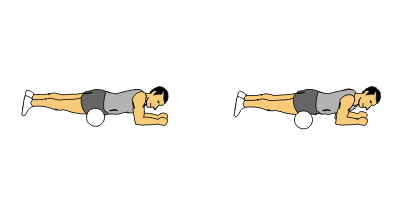 Quadriceps Slef Myofascial Release
1. Body is positioned prone (face down) with quadriceps on foam roll
2. It is very important to maintain proper core control (abdominal drawn-in position & tight gluteus) to prevent low back compensations
3. Roll from pelvic bone to knee, emphasizing the lateral (outside) thigh
4. If a tender point is located, stop rolling, and rest on the tender point until pain decreases by 75%.
 Iliotibial Band Self Myofascial Release
1. Position yourself on your side lying on foam roll.
2. Bottom leg is raised slightly off floor.
3. Maintain head in neutral position with ears aligned with shoulders.
4. This may be PAINFUL for many, and should be done in moderation.
5. Roll just below hip joint down the outside thigh to the knee.
6. If a tender point is located, stop rolling, and rest on the tender point until pain decreases by 75%.
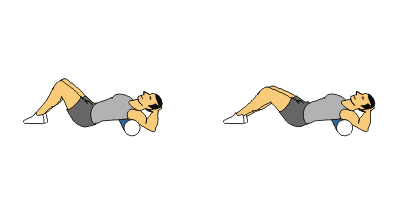 Upper Back Self Myofascial Release
1. Place hands behind head or wrap arms around chest to clear the shoulder blades across the thoracic wall.
2. Raise hips until unsupported.
4. Stabilize the head in a neutral position.
5. Roll mid-back area on the foam roll.
6. If a tender point is located, stop rolling, and rest on the tender point until pain decreases by 75%.
General Guidelines
- Spend 1-2 minutes per self myofascial release technique and on each each side (when applicable).
- When a trigger point is found (painful area) hold for 30-45 seconds.
- Keep the abdominal muscles tight which provides stability to the lumbo-pelvic-hip complex during rolling.
- Remember to breathe slowly as this will help to reduce any tense reflexes caused by discomfort.
- Complete the self myofascial release exercises 1-2 x daily.
As you can see there are many benefits to self Myofascial release. Time and effort spent is minimal for a maximal result.
collaroy@stepintolife.com
